Prop Firm 100 Profit Split 2026: Rules, Payouts & Real Costs Compared
A prop firm 100 profit split sounds like the perfect opportunity for traders to keep all their eligible trading profits, but the reality depends on each firm's payout rules and account conditions. Some proprietary trading firms offer 100% of profits up to a specific limit, while others require paid add-ons or performance milestones. Discover how profit splits work, compare leading prop firms, and understand the impact of evaluation fees, drawdown limits, payout caps, and withdrawal rules before choosing a funding program.
Can Prop Traders Really Keep 100% of Their Profits?
A 100% profit split sounds like the ultimate proposition in retail proprietary trading: you trade simulated firm capital, and every dollar of eligible gain goes straight into your pocket without a firm haircut. In the competitive 2026 prop ecosystem, multiple firms highlight a "100% profit split" across headlines, promotional banners, and scaling roadmaps. However, professional proprietary traders and quantitative analysts understand that headline payout percentages rarely reflect the full economic picture.
The critical distinction is operational structure. A headline 100% profit split is almost never an unconditional, day-one reality across every market cycle. In practice, one firm may grant 100% on the first bracket of earnings and drop to 90% thereafter. Another may start your split at 50% or 80%, requiring millions in simulated turnover and consecutive profitable quarters to unlock the 100% milestone. A third firm might unlock 100% payouts only if you purchase an optional add-on at checkout, while a fourth couples a nominal 100% split with restrictive withdrawal caps or tight trailing drawdown mechanisms that elevate challenge failure rates.
To evaluate whether a 100% profit-sharing program delivers real capital value, traders must evaluate the full equation: upfront evaluation fees, add-on surcharges, drawdown calculation engines, payout velocity, and contractual consistency rules. The headline split is merely the numerator; the rules governing whether you ever reach eligible withdrawal status form the denominator.
In direct answer for traders seeking immediate clarity: Yes, genuine 100% profit distributions exist in 2026, but almost universally carry explicit operational boundaries. Firms such as Apex Trader Funding grant 100% exclusively on the initial $25,000 of profits before reverting to 90%, while scaling programs like The5ers require growing simulated accounts to the $350,000 tier before lifting splits to 100%. Few, if any, reputable firms offer an unconditional, perpetual 100% base split on standard entry-level evaluations from day one without milestone, volume, or fee offsets. Traders researching a Prop Firm 100 Profit Split should carefully compare these conditions, including profit thresholds, payout limits, scaling requirements, and potential fees, rather than assuming that an advertised 100% split applies to all profits without restrictions.
Prop Firms with 100% Profit Split: Quick Answer
The following table summarizes firms that feature verified, contractually documented 100% profit split mechanisms in 2026, categorizing how that split is unlocked and its binding conditions.
| Prop Firm | Advertised Max Split | 100% From Start? | Conditions | Key Note |
|---|---|---|---|---|
| Apex Trader Funding | 100% | Yes (Tier Capped) | Applies only to the first $25,000 in cumulative profit per account. | Reverts to a 90% split thereafter; intraday trailing drawdown applies. |
| The5ers | 100% | No |
Earned through scaling; the 100% split begins at the $350,000 account level. | Starts at 80% on High Stakes, according to the stated program terms. |
| Goat Funded Trader | 100% | See Goat Funded Trader site | Homepage advertises "Up to 100% Split" and "100% Split on Demand"; check the plan terms. | Homepage lists a 4% maximum daily loss and a 6% maximum loss. |
Note: Competitor details were checked on each firm's official website as of 31 Oct 2026.
What Does a 100% Profit Split Actually Mean?
At its purely mathematical definition, a profit split represents the ratio of net eligible gains distributed to the trader versus the share retained by the proprietary trading firm.
Profit Split = Eligible Profit Paid to Trader ÷ Total Verified Net Profit Generated
Consider an account that generates $10,000 in cleared, eligible trading profits over a standard withdrawal cycle:
- At an 80% Split : The trader receives $8,000, and the firm retains $2,000.
- At a 90% Split : The trader receives $9,000, and the firm retains $1,000.
- At a 100% Split : The trader receives $10,000, and the firm retains $0 from that specific profit disbursement.
When a firm pays out 100% of generated profits, retail traders often wonder: How does the proprietary firm survive economically if it takes zero commission on trading earnings?
A 100% profit split does not mean the firm operates as a non-profit charity. Modern prop entities operate on multi-tiered balance-sheet economics. Revenue is generated through:
- Evaluation and Challenge Fees : Upfront assessment costs paid by participants attempting to qualify for funded simulation accounts.
- Account Resets and Retakes : Discounted or standard renewal fees collected when traders breach daily or overall drawdown rules.
- Paid Add-Ons and Customizations : Surcharges for faster payout cycles, higher leverage, weekend holding privileges, or higher initial splits.
- Activation and Platform Fees : Onboarding charges levied once a trader clears an evaluation stage.
- Back-End B-Book vs. A-Book Risk Offsetting : Internal risk desks identify consistently profitable traders and selectively route their trading signals into live institutional liquidity, earning flow-based execution margin or broker rebates.
When a firm grants 100% profit splits, the firm's earnings shift heavily toward challenge fees, add-on surcharges, or post-threshold tier reversions. A trader must evaluate whether the requirements to earn that 100% disbursement create structural headwinds that lower the statistical probability of receiving any payout at all.
Not All 100% Profit Splits Are the Same
Navigating 2026 prop firm offerings requires separating marketing language from contractual rules. Payout structures advertised as "100% split" fall into six distinct categories:
Standard 100% Split
Under this structure, a 100% split applies permanently as the default baseline across all funded payouts without requiring add-ons, promotions, or scaling. In the 2026 retail prop market, an unconditional, permanent 100% base split on standard two-step challenges is virtually non-existent among tier-one operators because it presents adverse structural risk to firm longevity unless offset by extreme evaluation failure rates or prohibitive challenge pricing.
Milestone-Based 100%
The trader begins at an industry-standard base split—typically 75% to 85%—and progressively unlocks higher tiers. To achieve 100%, the trader must satisfy rigorous performance thresholds, such as hitting consecutive 10% profit targets over 3 to 12 months, maintaining pristine drawdown records, or accumulating specified numbers of successful withdrawals. The5ers uses a variation of this performance-first architecture.
Promotional 100%
Firms frequently use temporary marketing campaigns offering "100% Profit Split on Your Next Challenge" or "100% Lifetime Split with Promo Code". These offers carry strict expiration dates and often contain secondary clauses in their Terms of Service: the promotional split may apply only to the first payout cycle, revert to 80% if the account suffers a drawdown breach, or apply only if specific minimum trading day counts are satisfied.
Add-On 100%
At checkout, the base evaluation fee might buy an 80% split. For an additional 15% to 30% surcharge, the trader can purchase a "100% Profit Split Add-On". This shifts upfront capital risk directly to the trader: you pay cash today for a benefit you only realize if you successfully pass the evaluation and achieve profitability.
First-Payout or Limited-Payout 100%
The firm grants a 100% split exclusively on initial distributions. This is dominant in the futures prop sector: Apex Trader Funding provides 100% on the first $25,000 per account. Once this dollar cap is cleared, the standard profit split drops to 90%.
Capped 100%
Under a capped 100% split, you keep 100% of your earnings, but the gross dollar extraction per withdrawal cycle is strictly limited. For instance, a firm might offer a 100% split but cap biweekly disbursements at $2,000 or $3,000, regardless of whether your trading generated $10,000 in eligible gains.
Treating all six models as interchangeable distorts risk-reward calculations. An upfront tier cap of $25,000 behaves very differently from a scaling tier that requires growing an account to $350,000 or more.
Best Prop Firms with 100% Profit Split in 2026
The following tables evaluate verified prop firms offering structured 100% profit-sharing mechanisms in 2026. Table A details the payout architecture, while Table B breaks down the corresponding risk parameters and entry costs. Not every trader needs a one-step evaluation to qualify for a funded account. Exploring 2 Step Programs can help traders understand multi-phase evaluation requirements, profit targets, drawdown limits, and the conditions for receiving payouts.
Table A: Profit Split Structure
| Firm | Base Split | Maximum Split | How 100% Is Reached | Payout Frequency |
|---|---|---|---|---|
| Apex Trader Funding | 100% | 100% | 100% on the first $25,000 in eligible profits per account; drops to 90% thereafter. | Two payouts per month (homepage); up to weekly on Intraday PAs (help centre). |
| The5ers | 80% | 100% | Achieved through milestone-based scaling; 100% begins at the $350,000 account level. | See The5ers site. |
| Goat Funded Trader | See Goat Funded Trader site | 100% | See Goat Funded Trader site (homepage: "100% Split on Demand"). | On demand; homepage promises payment within 2 business days or an extra $1,000. |
Table B: Challenge & Risk Parameters ($100K Account Equivalent)
Note: Pricing and parameters fluctuate based on promotional codes and operational updates; always confirm figures on the provider's official dashboard. Competitor details were checked on each firm's official website as of 31 Oct 2026.
Funded Trader Markets Profit Split
At Funded Trader Markets (FTM), we approach payout economics through structural sustainability and execution transparency rather than promotional marketing.
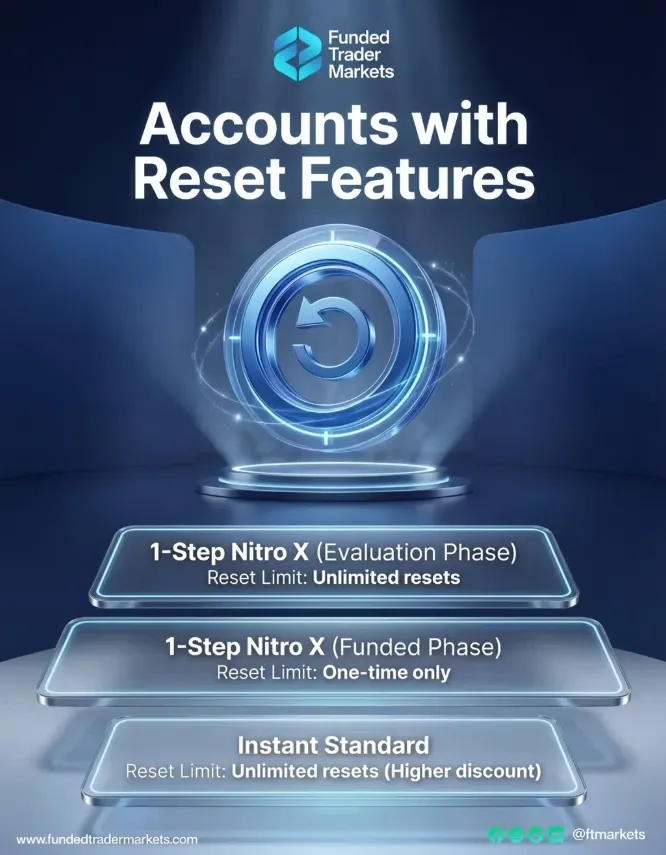
Funded Trader Markets does not advertise a standard, unconditional 100% baseline profit split on entry-level challenges. Our published splits vary by program: 1-Step Nitro pays 90% on the first $10,000 of profit and 80% thereafter; Instant Standard and Instant Pro step up from 50% on the first reward to 80% from the fourth; Instant Plus starts at 80%; and the current 2-Step Plus split is shown on the 2-Step page.
Our operational model is engineered around three primary trading pillars:
- On-Demand Rewards with a 24 Business-Hour Guarantee : While many firms mandate 14-day or 30-day waiting windows between payout requests, FTM processes reward requests on demand once the consistency rule, the minimum reward (1% of initial balance) and minimum trading days are met; live processing statistics are published on the rewards page. FTM aims to pay rewards within 24 business hours (8 AM–5 PM ET, Mon–Fri); if it misses that, the requested reward is doubled and a free account of the same size is added. This applies to rewards up to $1,000 and only if the trader responds to FTM's contact (Payments FAQ). Rewards are paid in USDT (TRC20) or via Rise (crypto or bank), with a 5% processing fee on crypto rewards.
- Static Balance-Based Drawdown on 2-Step Plus : Many firms advertising high headline splits utilize aggressive intraday trailing equity stops that eliminate accounts even when open trades temporarily retrace. FTM's 2-Step Plus uses a static balance-based drawdown model (10% overall loss limit; 4% daily limit of initial balance, recalculated at 5 PM ET). On a $100,000 2-Step Plus account, your maximum overall floor is fixed at $90,000. If your balance climbs to $110,000, your loss floor remains at $90,000, giving open positions an expanded $20,000 buffer. 1-Step Nitro uses a 6% limit that trails the highest recorded balance and locks at the initial balance once the account is up 6%.
- Execution Freedom : FTM allows news trading in all programs (news scalping around releases such as FOMC, NFP and CPI is prohibited, and funded trades closed within 1 minute have their profits voided), fully supports weekend position holding, and lists current pricing for each program on its programs page. Platform infrastructure includes cTrader, TradeLocker, Match-Trader and MetaTrader 5 (cTrader and MT5 are not intended for US residents). Evaluation models feature both our 2-Step Plus track and our 1-Step Nitro Challenge (single 10% profit target). Fees are not refunded; instead, a performance bonus equal to the purchase fee is paid with the third performance reward (not available on Instant Funding or 1-Step Infinity accounts).
Traders must assess whether an extra 10% on an advertised profit split compensates for a trailing drawdown mechanism that drastically lowers challenge pass rates.
Deep Dive into Verified 100% Profit-Split Firms
To make an informed allocation decision, traders should analyze the structural conditions of the leading firms that feature 100% payout structures.
Apex Trader Funding
Apex Trader Funding is an established presence in the CME futures prop sector. The firm is widely recognized for its tier-based payout structure: traders retain 100% of the first $25,000 in cleared profits per account.
- Base and Max Split : 100% on the first $25,000; 90% thereafter.
- Challenge Cost : See Apex's site for current evaluation pricing, which is frequently discounted during promotional sales.
- Profit Target and Drawdown : Profit target is approximately 6% ($6,000 on a $100K account). Drawdown is capped at $3,000 and calculates on an intraday trailing equity basis.
- First Payout and Frequency : Apex's homepage states two payouts per month, while its help centre describes up to weekly payouts on Intraday Performance Accounts once 5 qualifying trading days are met.
- Main Advantage : Upfront dollar capture. Clearing $25,000 in gains yields the full $25,000 without firm deduction.
- Main Consideration : The trailing intraday drawdown trails open, unrealized peak equity during a trade. If an open trade runs up $2,000 and pulls back $1,500, your drawdown floor trails upward, significantly narrowing your room for market volatility.
The5ers
Founded in 2016, The5ers offers longevity in the CFD and futures arenas. The firm provides a verified path to a 100% profit split, but does so strictly through performance scaling.
- Base and Max Split : Starts at 80% on High Stakes 2-Step evaluations; scales up to 100%.
- How 100% is Reached : Traders must grow their account through successive 10% targets; the 100% split begins at the $350,000 account level in The5ers' scaling table.
- Challenge Cost : See The5ers' site for current High Stakes pricing.
- Profit Target and Drawdown : 10% in Step 1, 5% in Step 2; features a 10% maximum loss limit and a 5% daily loss limit.
- First Payout and Frequency : A challenge-fee refund is listed on the High Stakes page; check The5ers' site for current payout frequency.
- Main Advantage : Long-term scaling milestones with a published path to a 100% split.
- Main Consideration : Reaching the 100% profit split tier requires substantial time, sustained profitability, and compounding over multiple quarters.
Goat Funded Trader
Goat Funded Trader offers CFD and forex evaluation challenges that feature multi-asset platform access and customizable account configurations.
- Base and Max Split : The homepage advertises "Up to 100% Split" and "100% Split on Demand"; check the specific plan for its starting split.
- How 100% is Reached : Not stated on the homepage; check the plan terms before purchasing.
- Challenge Cost : See Goat Funded Trader's site for current pricing.
- Profit Target and Drawdown : Check current targets on the official site; the homepage lists a 4% maximum daily loss and a 6% maximum loss.
- First Payout and Frequency : On-demand rewards; the homepage promises payment within 2 business days or an extra $1,000 (some sections say 24 hours).
- Main Advantage : A headline 100% on-demand split with a published payout-time promise.
- Main Consideration : A 4% daily loss limit leaves little margin for adverse market swings.
100% vs 90% vs 80% Profit Split
To cut through promotional rhetoric, traders must examine the raw dollar mathematics. The absolute difference between an 80%, 90%, and 100% profit split is straightforward: 10% of eligible profit per tier.
Profit Split Distribution Matrix
| Eligible Net Profit | 80% Split (Standard Base) | 90% Split (High-Tier Base) | 100% Split (Maximum Split) | Dollar Advantage (100% vs. 90%) |
|---|---|---|---|---|
| $2,000 | $1,600 | $1,800 | $2,000 | +$200 |
| $5,000 | $4,000 | $4,500 | $5,000 | +$500 |
| $10,000 | $8,000 | $9,000 | $10,000 | +$1,000 |
| $20,000 | $16,000 | $18,000 | $20,000 | +$2,000 |
| $50,000 | $40,000 | $45,000 | $50,000 | +$5,000 |
For a standard $10,000 profit disbursement, the incremental monetary benefit of a 100% split over a 90% split is exactly $1,000 .
While $1,000 is meaningful capital, traders must weigh that increment against the structural costs incurred to access it. If a firm charges a $150 add-on fee for a 100% split, mandates trailing intraday drawdown that triples your probability of account breach, or enforces a $3,000 bi-weekly payout cap, that theoretical $1,000 advantage can evaporate.
A 90% split backed by a static drawdown floor and fast on-demand withdrawals often provides a higher expected value (EV) than a conditional 100% split restricted by complex payout caps or trailing drawdown rules.
Does a 100% Split Actually Make a Prop Firm Cheaper?
Professional traders evaluate proprietary programs using net economic yield rather than headline payout splits.
Net Trader Economics = Payout Received − (Challenge Fees + Resets + Add-Ons + Activation Surcharges)
To illustrate the impact of these variables, consider an illustrative scenario comparing two distinct operational models attempting to clear $5,000 in eligible trading profits:
Hypothetical Comparison
- Firm A (Headline 100% Split with Trailing Drawdown & Paid Add-On)
- Advertised Split: 100% · Standard Challenge Fee ($100K Account): $450 · 100% Profit Split Add-On Surcharge: $120 · Evaluation Architecture: Trailing Intraday Equity Drawdown · Multi-Attempt Factor: Due to trailing drawdown sensitivity, the trader fails attempt one and passes on attempt two (1 reset / retake fee at $350) · Total Entry & Maintenance Costs: $450 + $120 + $350 = $920 · Gross Profit Achieved: $5,000 · Payout Disbursement (100%): $5,000 · Net Capital Realized by Trader : $5,000 - $920 = $4,080
- Firm B (Hypothetical 90% Split with Static Drawdown & No Surcharges)
- Advertised Split: 90% · Standard Challenge Fee ($100K Account): $329 · Add-On Fees: $0 (Standard 90% split built-in) · Evaluation Architecture: Static Balance-Based Drawdown (permanent $90K floor) · Multi-Attempt Factor: The static cushion allows normal trade retracements; the trader passes on attempt one. · Net Challenge Costs: $329 (fee not returned with the first payout) · Gross Profit Achieved: $5,000 · Payout Disbursement (90%): $4,500 · Net Capital Realized by Trader : $4,500 - $329 = $4,171
In this practical scenario, the trader using Firm B walks away with $91 more net capital despite trading under a lower headline percentage. Upfront add-on charges, trailing drawdown breaches, and fee structures can outweigh the mathematical difference between 90% and 100% splits.
Profit Split vs Drawdown
A high profit split is only useful if your account remains funded long enough to request a payout. In retail proprietary trading, drawdown architecture is the primary factor that dictates account longevity.
Prop firms primarily utilize three drawdown models:
1. Static Balance-Based Drawdown
The maximum loss limit is locked to your starting capital or fixed balance snapshot. On a $100,000 account with a 10% static loss limit, your account breaches only if your balance/equity drops below $90,000. If you generate $8,000 in profit, your account balance becomes $108,000, but your liquidation floor remains locked at $90,000. Your effective safety cushion expands from $10,000 to $18,000, allowing swing trades room to breathe through natural market fluctuations.
2. Trailing Intraday Equity Drawdown
Common among high-split futures and budget CFD operators, this drawdown mechanism calculates your maximum loss limit from your highest unrealized floating equity point in real time. If you enter a long position on a $100,000 account and the trade floats into +$2,500 profit before reversing to close at +$500, a trailing equity model ratchets your liquidation floor up by $2,500 immediately. If your allowed trailing loss was $3,000, your new breach level is now $99,500. Open market retracements can breach your account even while individual trades remain net-positive.
3. End-of-Day (EOD) Trailing Drawdown
The drawdown floor trails your closed account equity at the end of the daily session (typically 17:00 EST or 00:00 server time). While less punishing than tick-by-tick intraday trailing, it still moves your loss floor upward as your account grows, preventing you from building an expanding risk buffer.
Traders must not trade off a balanced, static risk architecture simply to target an unhedged 100% split. An account that hits an aggressive trailing stop yields zero payout, regardless of whether the advertised split was 80%, 90%, or 100%.
Payout Caps & Consistency Rules
When firms offer a 100% profit split, their back-office risk models frequently balance exposure by adding withdrawal caps and trading consistency rules.
Payout Caps
A payout cap sets a maximum ceiling on the dollar amount a trader can withdraw during a single payout cycle, regardless of total balance gains.
For example, imagine you generate $12,000 in net profit on a $100,000 funded account with an advertised 100% split:
- Without a Payout Cap: Your withdrawal request yields the full $12,000.
- With a $3,000 Payout Cap: You can only withdraw $3,000 for that cycle. The remaining $9,000 remains locked in your simulated balance, exposed to market risk during the subsequent trading period.
Payout caps are often tiered, starting low during the first 1 to 3 months of funding and scaling upward only after consecutive profitable withdrawal cycles.
Consistency Rules
A consistency rule dictates how evenly your profits must be distributed across multiple trading sessions. The most common variations include:
- Single-Day Profit Capping (e.g., 20% to 40% Rules) : No single trading session can account for more than a specified percentage (e.g., 25% or 30%) of your total accumulated profit at the time of withdrawal. If you generate $10,000 in total profit, but an unexpected economic news breakout netted you $4,000 on Tuesday (40% of the total), your payout request will be declined or delayed until you trade further sessions to dilute that single day's percentage.
- Lot-Size Consistency : Mandates that your executed lot sizes remain within a fixed percentage bandwidth (e.g., within 50% to 150% of your average trade size). A sudden shift from 2 lots to 10 lots can trigger an automatic rule breach or profit forfeiture.
Before joining any firm advertising a 100% split, review the Terms of Service for explicit payout caps and profit consistency percentages.
First Payout & Payout Frequency
Payout velocity is another key variable in evaluating prop firm economics. Payout policies typically operate across three distinct timelines:
- Bi-Weekly Cycles (14 Days) : The legacy industry standard utilized by firms like FTMO. The trader must wait until the 14th day after the first trade on the funded account before submitting an initial withdrawal request.
- Monthly Cycles (30 Days) : Common among traditional futures combines and institutional-style programs. Traders must hold profits in the simulated account for a full month before accessing capital, prolonging exposure to drawdown breach risk.
- On-Demand Payouts : The modern standard offered by firms like Funded Trader Markets. Once the consistency rule, the minimum reward and minimum trading days are met, traders can request withdrawals on demand without being bound to rigid bi-weekly or monthly windows. At FTM, live reward-processing statistics are published on the rewards page, and FTM aims to pay within 24 business hours (8 AM–5 PM ET, Mon–Fri); if it misses that, the requested reward is doubled and a free account of the same size is added (rewards up to $1,000; the trader must respond to FTM's contact).
Fast access to profits mitigates counterparty and operational risk. Withdrawing capital regularly locks in real-world gains and reduces the risk of giving back profits during volatile trading sessions. A 90% split disbursed on demand provides practical advantages over a nominal 100% split locked behind extended waiting periods and administrative reviews.
Scaling to 100% Profit Split
Many reputable prop firms offer 100% profit splits through earned performance scaling rather than day-one marketing.
Under a milestone scaling plan, a trader qualifies for larger account balances, higher leverage tiers, and enhanced profit allocations by hitting specific performance benchmarks. A typical scaling trajectory looks like this:
- Baseline Stage : Account Size: $100,000 | Base Profit Split: 80%
- Milestone 1 : Achieve 10% net profit over 3 consecutive months with at least 2 processed payouts. Simulated capital scales by 25% to $125,000; profit split upgrades to 85% .
- Milestone 2 : Generate an additional 10% net profit. Simulated capital scales to $160,000; profit split upgrades to 90% .
- Milestone 3 : Compounded returns clear institutional thresholds (scaling allocation past 500K–1M+). The firm elevates the trader to institutional status: 100% Profit Split + Monthly Performance Stipends.
When reviewing scaling plans that lead to a 100% split, confirm:
- Profit Target Threshold : Is the required gain calculated on initial balance or compounded balance?
- Withdrawal Reset Impact : Does requesting a payout reset your progress toward the next scaling milestone?
- Permanence : Once you reach the 100% tier, does it remain permanently locked, or does a drawdown period revert your split back to 80%?
Milestone scaling aligns the trader's interests with the firm's longevity. The firm provides higher splits to traders who have established a verifiable track record of disciplined risk management.
$100K Risk & Payout Example
To put profit splits and capital risk into perspective, traders must consider trade sizing and drawdown constraints. On a $100,000 simulated account with an industry-standard 5% daily loss limit ($5,000) and a 10% overall drawdown limit ($10,000), position sizing dictates how many consecutive losses the account can absorb before termination.
The table below illustrates the impact of risk-per-trade percentages across multiple trade sequences.
Risk Sizing and Consecutive Loss Exposure ($100K Account)
| Risk Per Trade (%) | Dollar Risk Per Position | 5 Consecutive Losses | 10 Consecutive Losses | Drawdown Buffer Consumed (10% Max) |
|---|---|---|---|---|
| 0.25% | $250 | $1,250 | $2,500 | 25.0% of Total Buffer |
| 0.50% | $500 | $2,500 | $5,000 | 50.0% of Total Buffer |
| 0.75% | $750 | $3,750 | $7,500 | 75.0% of Total Buffer |
| 1.00% | $1,000 | $5,000 | $10,000 (Account Breach) | 100.0% (Full Breach) |
Disclaimer: The above calculations are strictly educational models illustrating mathematical risk exposure. They do not account for slippage, execution spreads, or overnight swap fees.
Now, connect these risk dynamics to real-world payout expectations:
- Suppose a disciplined trader risks 0.50% ($500) per trade on a $100,000 account, maintaining a 1:2 Risk-to-Reward ratio.
- Over a monthly cycle, the trader nets a +5.0% gain ($5,000 in eligible profits) while staying well within the 10% static drawdown floor.
- Under a 100% split , the payout equals $5,000 .
- Under a 90% split , the payout equals $4,500 .
- Under an 80% split , the payout equals $4,000 .
If the trader chose an aggressive 100% split firm that enforced an intraday trailing drawdown, risking 0.50% during high-volatility sessions could easily trigger a trailing loss breach during an open retracement. The account would be liquidated, yielding $0 in payout and resulting in the forfeiture of the upfront evaluation fee. Sound risk management and clear drawdown rules are the foundation of any real payout.
Common Mistakes When Chasing a 100% Profit Split
Prop firm marketing is designed to emphasize upside potential while downplaying operational restrictions. When comparing 100% profit split options, traders often run into these common pitfalls:
- Assuming 100% Starts on Day One : Overlooking the fine print and discovering later that your account starts at 50% or 80%, requiring months of scaling milestones to reach the headline figure.
- Ignoring Paid Add-On Costs : Paying a 20% to 30% premium at checkout for an enhanced split that is entirely lost if the evaluation phase is failed.
- Overlooking Payout Caps : Assuming large account gains can be withdrawn immediately, only to encounter tight per-cycle withdrawal caps (e.g., maximum $2,000 per bi-weekly window).
- Disregarding Consistency Rules : Generating 60% of your challenge profits on a single market breakout, only to have your payout denied or delayed under single-day profit concentration rules.
- Trading Off Drawdown Quality : Choosing a firm with an intraday trailing equity stop over one with a static balance floor just to secure an extra 10% on an advertised split.
- Disregarding Payout Velocity : Overlooking 30-day waiting cycles that leave your capital exposed to prolonged market risk.
- Relying on Expired Promotional Terms : Purchasing challenges based on outdated reviews quoting limited-time marketing campaigns that are no longer supported.
- Comparing Mismatched Account Models : Evaluating a futures contract evaluation featuring monthly subscription fees against a one-time fee CFD challenge with a refundable deposit.
- Overlooking Country Restrictions : Investing time in an evaluation only to discover during KYC verification that your jurisdiction is excluded from profit distributions.
- Treating 100% Splits as Guaranteed Income : Forgetting that proprietary trading involves simulated capital evaluation where payouts depend entirely on strict rule compliance and market performance.
How to Compare 100% Profit-Split Prop Firms
When evaluating proprietary trading firms advertising 100% profit sharing, follow this structured 13-point framework before purchasing an evaluation:
- Verify Current Availability : Confirm on the firm's official pricing page or Help Center that the 100% split is active, rather than an expired promotion.
- Identify the Split Classification : Determine whether the 100% split is a standard base tier, an earned scaling milestone, an upfront paid add-on, or a capped initial tier (e.g., first $25K).
- Assess the All-In Evaluation Cost : Calculate the total purchase price, including any required add-on fees, platform access charges, and account reset costs.
- Evaluate Profit Targets : Check the required profit target across all evaluation phases (standard targets range between 6% and 10%).
- Inspect the Drawdown Engine : Determine whether drawdown is static balance-based, relative, or intraday trailing equity. Static drawdown provides the highest capital protection.
- Confirm First Payout Timing : Identify how many calendar and active trading days are required before you can request your initial payout (e.g., on-demand vs. 14-day or 30-day cycles).
- Check for Payout Caps : Confirm whether initial withdrawals are capped at a specific dollar amount or percentage of account equity.
- Check Consistency and Trading Style Rules : Verify whether the firm enforces single-day profit caps, lot-size bandwidths, or mandatory minimum profitable trading days.
- Review the Scaling Roadmap : If the 100% split is tied to scaling, confirm the exact balance thresholds, timeframes, and profit requirements necessary to reach that tier.
- Confirm Platform Infrastructure : Ensure the firm supports reliable, modern platforms that fit your trading workflow (e.g., TradeLocker, Match-Trader, cTrader, MetaTrader 5, or TradingView).
- Verify Country and Jurisdictional Eligibility : Review the firm's restricted countries list to ensure your residence is fully supported for KYC verification and banking/crypto withdrawals. Before choosing a proprietary trading firm, US-based traders should verify regional eligibility, account availability, and withdrawal restrictions. Read our guide to FundingPips US Clients 2026 to understand the latest eligibility requirements and important considerations for American traders.
- Calculate Net Trader Economics : Compare alternative programs—such as Funded Trader Markets' programs (static drawdown on 2-Step Plus; 90% on the first $10,000 of profit on 1-Step Nitro)—against high-split alternatives by factoring in pass rates, fee refunds or bonuses, and payout velocity.
- Select Based on the Full Program : Choose the firm whose overall risk parameters, trading flexibility, and execution stability best align with your personal trading strategy.
Final Takeaway
Headline payout percentages remain one of the most effective marketing hooks in retail proprietary trading. While a 100% profit split represents an attractive headline, experienced traders recognize that the commercial reality of prop trading is dictated by total program economics.
A 100% profit split can mean entirely different things depending on the provider:
- A tier-capped model that grants 100% on initial earnings before dropping to 90% (e.g., Apex).
- An earned milestone unlocked only after growing capital to a higher scaling tier (e.g., The5ers, from $350,000).
- An upfront paid add-on that adds risk to your evaluation phase.
- A marketing promotion that carries restrictive payout caps or single-day profit rules.
The incremental monetary gain of a 100% split over a 90% split is 10% of your eligible gains. If capturing that 10% requires navigating trailing equity stops, restrictive withdrawal caps, or extended holding periods, the actual probability of securing a payout drops significantly.
At Funded Trader Markets, our programs are built around balance-sheet stability and clear, trader-friendly rules. By offering published profit splits (90% on the first $10,000 of profit on 1-Step Nitro), static balance-based drawdown on 2-Step Plus, and on-demand rewards with a 24 business-hour guarantee (rewards up to $1,000; conditions apply), we provide an environment designed to support sustainable, long-term trading performance.
Evaluate prop firms on their complete operational structure—not just their marketing headlines.
Sources & Research References
Funded Trader Markets Official Sources
Funded Trader Markets — Payments and Withdrawals FAQ
https://fundedtradermarkets.com/faq/category/payments-and-withdrawals
Funded Trader Markets — FTMO vs Funded Trader Markets 2026 Comparison
https://fundedtradermarkets.com/ftmo-vs-funded-trader-markets
Funded Trader Markets — Best Prop Firms With Instant Payouts (2026)
https://fundedtradermarkets.com/best-prop-firms-with-instant-payouts
Funded Trader Markets — Best Prop Firm Static Drawdown 2026: Non-Trailing Accounts
https://fundedtradermarkets.com/prop-firm-static-drawdown
Funded Trader Markets — cTrader Store Official Profile
https://ctrader.com/prop-firms/fundedtradermarkets
Prop Firm Official Sources
Apex Trader Funding — Official Site and Payout Rules
https://apextraderfunding.com/, https://apextraderfunding.com/help-center/intraday-trailing-drawdown-accounts/intraday-trailing-drawdown-payouts/
The5ers — High Stakes Program Rules and Scaling Plan
https://the5ers.com/high-stakes/
Goat Funded Trader — Official Site
https://www.goatfundedtrader.com/
Payout / Program Documentation
TradeZella — Best Prop Trading Firms 2026 Rankings & Payout Economics
https://www.tradezella.com/blog/best-prop-trading-firms-2026-rankings
Platform & Industry Documentation
LuxAlgo Prop Research — Apex Trader Funding Rules & Operational Terms
https://www.luxalgo.com/prop-firms/apex-trader-funding/
PropFirmMarket — Best Prop Firms Directory & Profit Split Matrix 2026
https://propfirmmarket.in/
QuantVPS — Prop Firm Industry Statistics, Pass Rates & Payout Trends 2026
https://www.quantvps.com/blog/prop-firm-statistics
FAQs
Which prop firms offer a 100% profit split in 2026?
Prop firms offering 100% profit-split structures include Apex Trader Funding (on the first $25,000 in profits per account), The5ers (through scaling, from the $350,000 account level), and Goat Funded Trader (which advertises up to 100%). Other firms may offer 100% splits through paid add-ons or promotional campaigns. Always verify the latest official terms before purchasing a challenge.
Is a 100% profit split real?
Yes, 100% profit splits are real, but they usually come with specific conditions. They may apply only to an initial profit threshold, require traders to reach scaling milestones, or depend on purchasing an optional add-on. Review the firm's payout policy to understand exactly how and when the full profit split applies.
Do prop firms really let traders keep 100% of profits?
Yes, some prop firms allow traders to receive 100% of eligible profits under defined conditions. For example, under Apex Trader Funding's stated initial profit tier, eligible payouts can receive a 100% split up to the applicable $25,000 threshold per account. Firms may generate revenue through evaluation fees, account resets, platform charges, and their share of profits above the applicable threshold. Check current payout rules before relying on these terms.
Does Funded Trader Markets offer a 100% profit split?
Funded Trader Markets (FTM) does not advertise an unconditional 100% base profit split on standard entry-level challenges. On 1-Step Nitro, the published split is 90% on the first $10,000 of profit and 80% thereafter; Instant Standard and Pro step up from 50% to 80%, and Instant Plus starts at 80%. FTM pays rewards on demand with a 24 business-hour guarantee (rewards up to $1,000; conditions apply), uses static balance-based drawdown on 2-Step Plus, and pays a performance bonus equal to the purchase fee with the third performance reward (not available on Instant Funding or 1-Step Infinity accounts). Review the official program and payout conditions for eligibility details.
Is a 100% profit split better than a 90% profit split?
Not necessarily. On $10,000 in eligible profits, a 100% split pays $10,000, while a 90% split pays $9,000. However, additional fees, restrictive payout caps, trailing drawdown rules, and withdrawal delays can reduce the practical value of a higher split. Compare the full program costs, risk rules, and payout conditions before choosing a firm.
Do 100% profit-split prop firms charge higher fees?
Some prop firms charge additional fees for 100% profit-split upgrades, while others include limited 100% tiers in their standard pricing. Challenge fees, reset charges, platform costs, and optional add-ons can all affect your net earnings. Compare the total cost of obtaining and maintaining an account rather than focusing only on the advertised split.
Are 100% profit splits usually promotional?
Some 100% profit-split offers are temporary promotions, while others are permanent but limited to specific profit thresholds or scaling tiers. Apex Trader Funding has advertised a 100% split on an initial profit bracket, whereas other firms may require add-ons or performance milestones. Confirm whether the offer is active and review the official terms before purchasing.
Can a prop firm cap payouts even with a 100% split?
Yes. A 100% profit split does not necessarily mean you can withdraw all eligible profits immediately. A firm may impose maximum withdrawal amounts, staged payout limits, minimum trading days, or other eligibility requirements. Check the payout policy to determine how much you can withdraw per cycle and when the remaining profits become eligible.
How do scaling plans affect profit splits?
Scaling plans increase account allocations or profit-sharing percentages when traders meet specific performance requirements. Some programs begin with an 80% split and gradually increase the percentage as traders achieve milestones, while others may offer a path to 100% only at higher account tiers. Review the required profit targets, payout history, account thresholds, and conditions for retaining the upgraded split.
What should I check before choosing a 100% profit-split prop firm?
Check whether the 100% split applies from day one or requires scaling, whether an add-on fee is necessary, and whether the offer has a profit threshold. Also review static or trailing drawdown rules, payout caps, withdrawal processing times, consistency requirements, evaluation fees, and country eligibility. These conditions help you assess the real value of the program beyond its headline profit split.
Alex Mercer, Prop Trader & Funding Specialist
Alex Mercer is a full-time prop trader and funding specialist with 7+ years in the forex and CFD markets. He’s been funded by FundingPips, FundedNext, The5ers, and Funded Trader Markets, and currently manages multiple six-figure funded accounts across FTM and The5ers. Alex has withdrawn over $180,000 in prop firm payouts since 2022. His reviews are based on firsthand experience and direct feedback from a network of 200+ active funded traders. No compensation was received from any firm for this review.
Continue exploring General Tips
The Funded Trader Review 2026: Hidden Rules, Payouts, and the Top Alternative

Best Prop Firm for Funded Traders 2026: Payouts, Rules & Scaling Compared