Best Cheaper Alternative to FTMO in 2026: Low-Cost Prop Firms That Actually Pay Out
Looking for a cheaper alternative to FTMO in 2026? Compare low-cost prop firms, payout speeds, drawdown rules, 1-step evaluations, and US-friendly platforms to find the right funded trading option.
Best Cheaper Alternative to FTMO in 2026: Low-Cost Prop Firms That Actually Pay Out
Looking for a cheaper alternative to FTMO in 2026? Compare low-cost prop firms, payout speeds, drawdown rules, 1-step evaluations, and US-friendly platforms to find the right funded trading option.
Trading prop firm capital has fundamentally changed, with many traders now searching for a cheaper alternative to FTMO that offers lower evaluation costs and flexible funding options. However, paying €439–€540 for a standard $100,000 evaluation (FTMO's current and list price for its 2-Step Challenge, as of 31 Oct 2026) has priced thousands of disciplined, undercapitalized traders out of the market. When you factor in the mathematical probability of needing multiple attempts to pass strict two-phase criteria, the upfront capital expenditure required to secure an FTMO account can easily exceed $1,500.
This cost barrier has driven a massive migration toward budget-friendly prop firms. Yet, the search for cheaper alternatives introduces a dangerous hazard: the "cheap challenge trap." A wave of predatory platforms sells $30 to $50 evaluations engineered with hidden drawdown tripwires, severe synthetic slippage, and arbitrary terms of service designed to deny withdrawals.
A cheap challenge is only as good as the payout behind it. Saving $200 on an entry fee is meaningless if the firm refuses your five-figure wire transfer or freezes its execution engine during market-moving news events.
A cheap challenge is only as good as the payout behind it. Saving $200 on an entry fee is meaningless if the firm refuses your five-figure wire transfer or freezes its execution engine during market-moving news events.
1. The Real Cost of Funding: FTMO vs. The Modern Budget Market
The primary driver behind the search for FTMO alternatives is capital efficiency. When assessing risk-to-reward on an evaluation fee, professional traders look at the Cost per Unit of Real Drawdown Capital, rather than the headline account balance.
| Evaluation Metric | FTMO ($100K Acct) | Modern Low-Cost Competitor |
|---|---|---|
| Upfront Evaluation Cost | €439 (list €540), 2-Step, as of 31 Oct 2026 | Varies by firm (see Section 4) |
| Maximum Total Loss (DD) | $10,000 (10%) | $6,000 - $10,000 |
| Maximum Daily Loss | $5,000 (5%) | $3,000 - $5,000 |
| True Cost per $1K Risk | €43.90 - €54.00 | Varies by firm |
| Evaluation Structure | 1-Step, 2-Step or Instant | 1-Step or 2-Step |
| US Trader Availability | Via FTMO US (OANDA partnership) | Varies by firm |
The data shows that standard legacy firms charge a steep premium for their brand equity. For an active day trader or swing trader seeking multi-account diversification, paying up to €540 per entry limits portfolio sizing.
The "Cheap Challenge Trap" Exposed
In response to market demand, numerous pop-up firms have flooded social media with $20 to $40 entry fees. These low-cost evaluations frequently hide structural mechanisms designed to fail traders:
- Intraday Trailing Drawdown on Unrealized High-Water Equity: Instead of locking your drawdown to the end-of-day balance, your loss limit trails your live floating profit tick-by-tick. If you are up $3,000 on an open position and the trade retraces by $2,000, you breach the account despite remaining positive on the trade.
- Arbitrary 15% to 30% Consistency Rules: Traders only discover at the withdrawal stage that no single trading day or trade can account for more than 15%–30% of their total profit, forcing them to overtrade and forfeit their account balance.
- Synthetic Liquidity Routing & Artificial Spreads: Budget operators often route demo feeds through low-tier liquidity bridges, inflating EUR/USD spreads to 3.5 pips during London/New York overlaps and executing stops well beyond market prices.
- KYC & Payout Stalling Cycles: Legitimate payouts are delayed for weeks under the guise of "manual compliance reviews," hoping the trader gets impatient, continues trading, and violates a risk parameter before the transfer executes.
2. The Evaluation & Weighted Scoring Framework (Tailored for Budget Traders)
To filter out predatory operations and rank viable low-cost alternatives, we built an empirical, five-pillar evaluation model. This framework assigns mathematical weightings based on the priorities of budget-conscious, payout-focused traders.
EVALUATION & WEIGHTED SCORING FRAMEWORK
Entry Cost-to-Capital Efficiency
- 35% Weight
Payout Reliability & Speed
- 25% Weight
Rule Forgivingness & Drawdown Logic
- 20% Weight
Hidden Fee & Subscription Transparency
- 10% Weight
Platform Execution & Global Access
- 10% Weight
1. Entry Cost-to-Capital Efficiency (35% Weight)
This metric measures the nominal entry fee relative to the virtual capital received and the permitted drawdown cushion.
$$\text{Capital Efficiency Ratio} = \frac{\text{Maximum Allowed Drawdown (\$)}}{\text{Challenge Entry Fee (\$)}}$$
A higher ratio indicates greater room for market volatility per dollar spent on the challenge fee. Firms charging over $500 for a $10K loss buffer receive lower efficiency ratings than those offering equivalent buffers for $300 to $380.
2. Payout Reliability & Speed (25% Weight)
A low entry fee is worthless if funded profits cannot be withdrawn cleanly. We evaluate:
- Processing time from withdrawal request to funds hitting the trader’s bank account or crypto wallet.
- Contractual payout settlement guarantees (e.g., 24-hour turnaround commitments).
- Volume of independently audited, non-affiliated payment proofs published within verifiable third-party communities.
3. Rule Forgivingness & Drawdown Logic (20% Weight)
The operational mechanics of how risk is calculated determine whether a funded account survives normal market distribution:
- Static vs. Trailing Drawdown: Traders comparing end of day drawdown prop firms should prioritize models that calculate drawdown from the closing balance rather than continuously adjusting it from intraday floating equity.
- News Trading & Weekend Holding: Unrestricted execution during macroeconomic data releases (CPI, NFP, FOMC) and flexibility to hold positions through market close.
- Time Constraints: Elimination of mandatory calendar deadlines, giving traders unlimited time to hit profit targets without psychological rushing.
4. Hidden Fee & Subscription Transparency (10% Weight)
Low initial challenge fees often disguise backend monetization schemes. We penalize firms that require:
- Mandatory monthly platform subscription or data connection fees.
- Excessive withdrawal processing charges or crypto conversion surcharges.
- Non-refundable resets priced higher than initial challenge fees.
5. Platform Quality & US/Global Accessibility (10% Weight)
Following international regulatory shifts that restricted MetaQuotes (MT4/MT5) for US clients across numerous brokerages, access infrastructure is essential:
- Deployment of modern platforms such as TradeLocker, Match-Trader, and cTrader.
- Server uptime, low execution latency, and zero artificial requoting during high-volatility sessions.
3. Deep-Dive Spotlight: Funded Trader Markets (FTM)
- Overall Score: 9.4 / 10
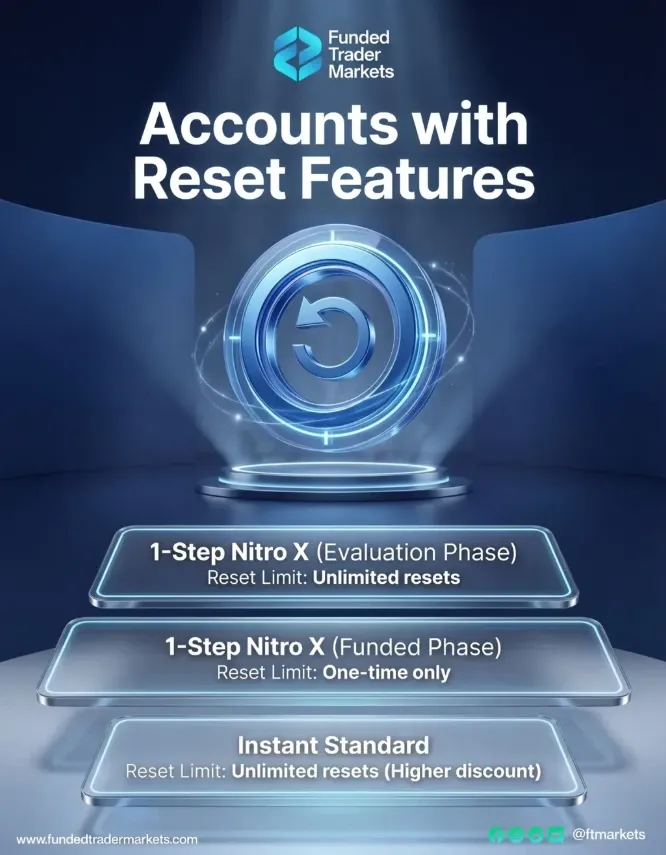
- Best Known For: Payout Reliability, 1-Step Nitro Challenges
- Official Website: fundedtradermarkets.com
| Feature | FTM Operational Metric |
|---|---|
| Evaluation Models | 1-Step Nitro & 2-Step Plus |
| Standard Payout SLA | On demand; 24 business-hour guarantee (rewards up to $1,000; conditions apply) |
| Platform Ecosystem | TradeLocker, Match-Trader, MT5, cTrader |
| US Trader Access | cTrader and MT5 not intended for US residents; confirm eligibility with FTM support |
| Profit Split | Up to 90% (evaluations) |
Funded Trader Markets (FTM) positions itself as an alternative to legacy European firms by addressing one of the most common pain points in modern prop trading: payout velocity.
[FTM Platform Ecosystem]
Funded Trader Markets (FTM)
TradeLocker
Trading Platform
Match-Trader
Trading Platform
MetaTrader 5
MT5 Platform
cTrader
Trading Platform
Institutional Platform Architecture for Global Traders
Following the industry-wide platform reshuffling in 2024, many low-cost firms abruptly canceled US customer accounts. FTM offers four platforms, chosen before purchase:
- TradeLocker and Match-Trader: Available on FTM accounts. US-based traders should confirm current eligibility with FTM support before purchasing.
- International Traders: Retain full access to the MetaTrader 5 (MT5) and cTrader suites, providing automated Expert Advisor (EA) execution and customizable algorithmic workflows. FTM states that these two platforms are not intended for US residents, and US IPs cannot trade on them.
24 Business-Hour Payout Guarantee
Where FTM differentiates itself most clearly from traditional models is in capital disbursement:
- Standard On-Demand Payouts: Rewards can be requested on demand once the consistency rule, the minimum reward (1% of initial balance) and the minimum trading days are met, and are paid via USDT (TRC20) or Rise (crypto, or bank via Rise), with a 5% processing fee on crypto rewards. This bypasses the conventional 14-day to 30-day payout cycles typical of legacy firms.
- 24 Business-Hour Guarantee: FTM aims to pay rewards within 24 business hours (8 AM–5 PM ET, Mon–Fri). If it misses that window, the requested reward is doubled and a free account of the same size is added. This applies to rewards up to $1,000 and only if the trader responds to FTM's contact (payments FAQ).
The 1-Step Nitro Evaluation
For traders seeking to minimize time spent in evaluation phases, FTM’s headline product is the 1-Step Nitro Challenge:
Standard 2-Step Evaluation
Phase 1
8%–10% Target
Phase 2
5% Target
Verification
Account Verification
Funded Stage
20–60 Days
FTM 1-Step Nitro Challenge
Single Phase
10% Target
KYC Verification
Identity Verification
Funded Stage
Minimum 5 Days of ≥0.5% Profit Before a Reward
By eliminating the secondary verification phase, the Nitro challenge has no minimum trading days in evaluation, reducing psychological fatigue and operational risk exposure.
Pros vs. Considerations
Pros vs. Considerations
Key features and important factors to evaluate
Pros
Execution architecture with seamless TradeLocker integration
On-demand rewards with a 24 business-hour guarantee (rewards up to $1,000; conditions apply)
Balance-based 10% static drawdown on 2-Step Plus; Nitro's 6% trailing limit locks at the initial balance once the account is up 6%
Considerations
Advanced educational material assumes foundational technical proficiency
Nitro challenges require strict risk-per-trade discipline due to tighter loss caps
4. Top 5 Cheap FTMO Alternatives for 2026 (Ranked & Detailed Matrix)
Below is an exhaustive breakdown of the top five budget-friendly prop firms in 2026 that combine lower entry costs with verified payout infrastructure. Competitor figures were checked on each firm's official website as of 31 Oct 2026.
| Firm Name | $100K Cost | Profit Target | Drawdown | Refundable? | Payout | US Status |
|---|---|---|---|---|---|---|
| Funded Trader Markets | See current pricing | 10% (Nitro) / 8% + 5% (2-Step Plus) | 6% trailing with lock (Nitro) / 10% static (2-Step Plus) | No (bonus equal to fee paid with 3rd reward; not on Instant/Infinity) | On demand; 24 business-hour guarantee (rewards up to $1,000; conditions apply) | Confirm with FTM (cTrader/MT5 not for US residents) |
| FundedNext | $549.99 | 8% / 5% | Balance-Based | Yes |
99.99% within 24h; 1st reward after 21 days, then every 14 days | Match-Trader available to US clients |
| FundingPips | $529 | 8% / 5% | See FundingPips site | See FundingPips site | Weekly, bi-weekly, monthly or on-demand (split varies) | See FundingPips site |
| Blue Guardian | See Blue Guardian site | See Blue Guardian site | See Blue Guardian site | See Blue Guardian site | 7 days (1-Step / 2-Step) | See Blue Guardian site |
| MyFundedFutures | See MyFundedFutures site | See MyFundedFutures site | EOD Trailing (most plans) | See MyFundedFutures site | Every 48 hrs, daily or bi-weekly (by plan) | See MyFundedFutures site |
Detailed Breakdown of the Top 5 Contenders
1. Funded Trader Markets (FTM) — The Overall #1 FTMO Alternative
- Score: 9.4 / 10
- Typical $100K Pricing: See current pricing (promotional prices change)
- Max Drawdown: 4% Daily / 6% Trailing, locking at initial balance after +6% (1-Step Nitro); 4% Daily / 10% Static (2-Step Plus)
FTM earns the top spot in the FTMO vs Funded Trader Markets comparison by combining budget pricing with reliable execution and payouts. While FTMO charges €439 (list price €540, as of 31 Oct 2026) for a $100K 2-Step evaluation, FTM's current $100K pricing is lower, backed by on-demand rewards with a 24 business-hour guarantee (rewards up to $1,000; conditions apply) and a choice of TradeLocker, Match-Trader, MT5, and cTrader. The 1-Step Nitro program provides one of the fastest routes to verified funding on the market today.
2. FundedNext — Best for Evaluation Profit Share
- Score: 7.9 / 10
- Typical $100K Pricing: $549.99 (Stellar 2-Step, as of 31 Oct 2026)
- Max Drawdown: 10% Maximum / 5% Daily
- Scaling Ceiling: See FundedNext site
FundedNext altered the prop industry by introducing a 15% profit share on evaluation phases (15% of challenge profit targets, paid at the first scale-up), allowing traders to earn real cash while passing their challenges. Their pricing is competitive with FTMO, and FundedNext states that 99.99% of rewards are processed within 24 hours, with the first reward after 21 days and later rewards every 14 days. Their multi-platform support across cTrader and MT5 makes them a strong choice for automated and discretionary traders alike.
3. FundingPips — Best Low-Cost Entry
- Score: 7.2 / 10
Typical $100K Pricing: $529 (as of 31 Oct 2026)
- Max Drawdown: 10% Maximum / 5% Daily
- Scaling Ceiling: See FundingPips site
FundingPips became a high-volume budget favorite by lowering evaluation fees across smaller account tiers ($5K to $25K). Funded traders can choose a weekly, bi-weekly, monthly or on-demand payout schedule, with the profit split varying by schedule.
4. Blue Guardian — The Most Forgiving Rule Set
- Score: 8.1 / 10
- Typical $100K Pricing: See Blue Guardian site
- Max Drawdown: See Blue Guardian site
- Scaling Ceiling: See Blue Guardian site
Blue Guardian differentiates itself through a range of plan types with different payout cadences. It advertises payouts in 7 days on its 1-Step and 2-Step plans, says approved payouts are processed in about 1 hour on average, and promotes a 24-hour payout guarantee, making it a reliable second option.
5. MyFundedFutures — Best Cheap Alternative for Futures Traders
- Score: 8.3 / 10
- Typical $100K Pricing: See MyFundedFutures site (one-time payment, no activation fee)
- Max Drawdown: End-of-Day Trailing on Builder, Rapid EOD and Pro plans (Rapid is intraday)
- Scaling Ceiling: See MyFundedFutures site
For traders willing to shift from CFD/Forex markets to CME exchange-traded futures (ES, NQ, CL, GC), MyFundedFutures provides an affordable path to funded capital. Entry costs are a one-time payment with no activation fee or renewals, and supported platforms include Tradovate and Quantower. Payout frequency depends on the plan: every 48 hours on Builder, daily on Rapid and Rapid EOD, and bi-weekly on Pro.
5. The Structural "Catch" Behind Low-Cost Challenges
%20Top%205%20highest-6.webp)
To evaluate prop firms safely, traders must understand the business models behind low evaluation costs:
[Operational Models in the Budget Prop Firm Sector]
OPERATIONAL MODELS IN THE BUDGET PROP FIRM SECTOR
A. Lean Automated Operations (Sustainable)
- High volume of challenge participants
- Automated risk management & auto-KYC pipelines
- A-Book hedging on top-tier consistent traders
- Thin profit margins balanced by scale
B. Predatory Fee-Harvesting (Unsustainable / Trap)
- 100% dependent on challenge failure fees
- Trailing intraday high-water drawdowns
- Delayed payouts & fabricated compliance breaches
- Hidden lot-size & 15% consistency restrictions
Model A: High-Volume, Lean Margin Operations
Legitimate low-cost prop firms operate like modern fintech brokerages. By automating risk systems, streamlining KYC compliance, and reducing marketing overhead, they can lower challenge costs while maintaining balance sheet liquidity.
These firms generate revenue from evaluation volume and mirror the trades of their top-tier funded traders in real institutional liquidity pools (A-Book execution), creating long-term structural alignment between the prop firm and the winning trader.
Model B: The Predatory Fee-Harvesting Pyramid
Predatory firms offer artificially low prices (20–50) as pure loss leaders. Because their infrastructure is unbacked by real liquidity partnerships or balance sheet capital, they rely entirely on incoming challenge purchases to pay prior withdrawals.
To prevent large payouts from disrupting their cash flow, these operators introduce strict terms:
- Unannounced adjustments to maximum lot sizes.
- Banning swing trades by prohibiting holding over weekends without explicit advance permission.
- Classifying ordinary price action scalping as "toxic flow" or "platform exploitation."
Understanding these operational dynamics makes it clear why selecting a structurally sound firm like FTM is essential when stepping outside the legacy FTMO ecosystem.
6. Hidden Red Flags to Avoid When Buying Cheap Challenges
When evaluating alternative prop firms, watch for these common operational warning signs:
| Red Flag Indicator | Hidden Risk & Impact on Payouts |
|---|---|
| Trailing Intraday DD | Calculates loss limits off floating profit peaks, stopping you out during mid-trade pullbacks. |
| Recurring Hidden Fees | Low upfront cost accompanied by monthly recurring platform, data feed, or maintenance charges. |
| Sudden Rule Alterations | Introducing consistency rules or lot limits after you submit a withdrawal request. |
| Volatility "Maintenance" | Servers freeze during major economic news (NFP, FOMC), triggering slippage breaches. |
| Opaque Corporate Structure | Inability to identify operating executives or parent corporate entities on commercial registries. |
| Community Censorship | Locking Discord channels or mass-deleting negative Trustpilot reviews regarding payout delays. |
1. Trailing Drawdown on Intraday Floating Equity
Always verify whether the drawdown is Balance-Based (Static) or Trailing Equity-Based. A balance-based drawdown (the standard on FTMO's 2-Step and FTM's 2-Step Plus) only locks your loss limit to your starting or closed daily balance. A trailing intraday equity model ratchets your drawdown floor up with floating profit, significantly reducing your true risk buffer.
2. High Mandatory Recurring Platform & Data Fees
Certain platforms advertise a $100K challenge for under $100, but obscure terms requiring an active 50–80 monthly data feed connection to keep the account active. A legitimate challenge fee should be a one-time purchase.
3. Server Outages During Volatility Windows
Firms that lack deep institutional liquidity infrastructure often struggle with execution stability during tier-one macro releases. If a platform regularly experiences technical disconnects during FOMC or CPI releases, you risk being stopped out or locked out of open positions.
[Red Flag Checklist for Budget Prop Firms]
Red Flag Checklist
5 Critical Checks for Budget Prop Firms
Before Choosing a Prop Firm
Review these five critical factors before committing your capital.
7. Real US Trader Case Study & Numbers
Below is a real-world performance breakdown from a US-based trader who transitioned from high-cost legacy evaluations to a scalable alternative.
[ Trader Performance Case Study ]
Jenna K.
Austin, TX | Futures Scalping Consistency
Apex Trader Funding
$150,000 Starting Challenge
CME Equity Futures
NQ & ES Contracts
$8,000 – $12,000
Average Monthly Pull
$150K – $300K
Account Growth Milestone
Jenna struggled with strict daily loss limits on conventional multi-phase forex challenges. Moving to a dedicated futures platform allowed her to trade without an intraday daily loss tripwire, managing her risk entirely around trailing threshold parameters.
"You have to respect the leverage on index futures," Jenna explains. "The low entry cost let me set up multiple accounts simultaneously. By keeping my position sizing under 1% total risk per play, I run a scaled $300K account that yields consistent monthly distributions without balance anxiety."
8. Actionable Advice & Final Verdict
%20Copy%20of%20blog-Howtobuildstrongtradingdisciplinev1-19.01.2026-3.webp)
To build a sustainable funded trading career on a budget, you need a systematic capital allocation strategy.
5-Step Blueprint for the Budget Funded Trader
A structured approach to funded trading
Determine Total Risk Budget
Max 15% liquid cash allocation
Target Verified Promotional Cycles
Utilize 20%–50% discounts
Select Evaluation Architecture
Choose between 1-Step vs. 2-Step model
Establish First-Payout Reinvestment Protocol
Create a structured reinvestment strategy
Build Multi-Firm Diversification
Minimize risk through diversification
The 5-Step Budget Trader Roadmap
Step 1: Establish Your Evaluation Risk Budget
Never spend more than 15% of your total available liquid trading capital on prop evaluation fees. If you have $2,000 in personal capital, your maximum budget for challenges should be capped at $300. This provides enough buffer to secure a $100K evaluation without financial strain.
Step 2: Time Active Promotional Windows
Major prop firms regularly run official flash discounts ranging from 20% to 50% off standard challenge fees during major market holidays and seasonal campaigns. Never pay full retail price for a challenge. Securing a $100K account at FTM or FundedNext during a 30% discount cuts your upfront entry cost by 30%; see FTM's current pricing.
Step 3: Match the Challenge Architecture to Your Strategy
- Choose 1-Step (Nitro) Challenges: If your trading edge relies on high-probability swing trading or momentum trend-following where you want to reach funded status quickly.
- Choose 2-Step Challenges: If you trade intraday scalping strategies that benefit from lower profit targets per phase (e.g., 8% Phase 1 / 5% Phase 2) and wider overall drawdown allowances.
Step 4: Reinvest Your Initial Payout into Capital Redundancy
When you receive your first funded payout, withdraw the full amount and immediately set aside an amount equal to your initial challenge fee. Use a portion of the remaining profit to fund a secondary evaluation with a complementary firm, creating an operational cushion.
Step 5: Diversify Your Prop Firm Stack
Avoid keeping all your funded allocation under a single umbrella. The optimal setup for an active trader in 2026 is maintaining primary funding with a fast-payout multi-asset firm like Funded Trader Markets (FTM), supported by a futures-specific platform like Apex or Topstep. This ensures you retain access to markets and active capital, regardless of regulatory or technical disruptions.
Final Verdict
You no longer need to spend up to €540 on legacy evaluations like FTMO to build a substantial funded trading business. The modern prop firm landscape offers genuine capital efficiency, provided you avoid the traps of cheap fee-harvesting schemes.
For traders looking for a reliable, cost-effective alternative in 2026, Funded Trader Markets (FTM) provides the strongest overall combination of low entry costs, flexible 1-Step Nitro evaluations, a choice of four trading platforms, and on-demand rewards backed by a 24 business-hour guarantee (rewards up to $1,000; conditions apply). Pair competitive pricing with disciplined risk management, let your operational edge play out over a meaningful sample of trades, and leverage low-cost challenges to scale your trading business safely.
FAQs
What is the best cheaper alternative to FTMO in 2026?
Funded Trader Markets (FTM) is one of the leading cheaper alternatives to FTMO, offering lower-cost evaluation options, flexible challenge structures, and fast payout options.
What are the best cheap FTMO alternatives?
Popular cheap FTMO alternatives include Funded Trader Markets, FundedNext, FundingPips, Blue Guardian, and MyFundedFutures. Compare pricing, drawdown rules, platforms, and payout policies before choosing a firm.
Is Funded Trader Markets cheaper than FTMO?
Yes. Funded Trader Markets offers lower-cost evaluation options than a standard FTMO $100K challenge, making it an attractive cheaper alternative to FTMO for budget-conscious traders.
What should I look for in a cheaper alternative to FTMO?
Look beyond the challenge fee. Compare maximum drawdown, daily loss limits, payout speed, trading restrictions, platform availability, refund policies, and whether the firm supports traders in your country.
Which cheap FTMO alternative has fast payouts?
Funded Trader Markets is positioned as a fast-payout option. FTM aims to pay rewards within 24 business hours (8 AM–5 PM ET, Mon–Fri); if it misses that window, the requested reward is doubled and a free account of the same size is added, for rewards up to $1,000 and only if the trader responds to FTM's contact. Always review the firm's current payout terms before purchasing.
Are cheap FTMO alternatives available to US traders?
Some cheap FTMO alternatives offer access to US traders through platforms such as TradeLocker and Match-Trader. Availability can vary by firm and may change based on regional restrictions. At FTM, cTrader and MT5 are not intended for US residents, so US-based traders should confirm current eligibility with FTM support before purchasing.
What is the difference between FTMO and Funded Trader Markets?
The main differences to compare are evaluation cost, challenge structure, drawdown rules, platform availability, US accessibility, and payout terms. For traders focused on lower upfront costs, Funded Trader Markets can be considered a cheaper alternative to FTMO.
Are 1-step challenges better than FTMO's 2-step evaluation?
A 1-step challenge can be faster because traders do not need to complete a second evaluation phase. However, whether it is better depends on the profit target, drawdown structure, and individual trading strategy.
What are the risks of choosing cheap FTMO alternatives?
The lowest-priced challenge is not always the best option. Traders should check for trailing drawdowns, hidden fees, restrictive consistency rules, trading limitations, unclear payout policies, and sudden rule changes before purchasing.
How do I choose the best cheaper alternative to FTMO in 2026?
Compare cheap FTMO alternatives based on total evaluation cost, drawdown allowance, profit targets, payout reliability, platform options, US availability, and rules that fit your trading strategy. The cheapest challenge should not automatically be considered the best choice.
マーカス・チェン, プロップ取引アナリスト
Marcus Chenは外国為替、株価指数、コモディティ全般にわたる8年以上の経験を持つプロプライエタリートレーダーです。彼は2021年に初のFTMOチャレンジをクリアし、最大$200Kまでのスケールドアカウントを取引し、2024年のFTMOの米国撤退の直接的な影響を受けました。それ以来、FundedNext、FundingPips、ThinkCapital、Audacity Capital、Funded Trader Marketsを含む14社以上のプロップファームを個人的に試しました。彼は現在、Funded Trader Markets(FTM)を主要ファームとして資金提供口座を取引しており、ブローカー支援による分散化のためThinkCapitalアカウントを維持しています。マーカスはロンドン市場セッションのゴールドとEUR/USDの取引を専門としており、ブレイクアウトとモメンタム戦略に重点を置いています。すべての意見は直接の取引経験と検証済みのペイアウト実績に基づいています。