Best Cheaper Alternative to FTMO in 2026: Low-Cost Prop Firms That Actually Pay Out
Looking for a cheaper alternative to FTMO in 2026? Compare low-cost prop firms, payout speeds, drawdown rules, 1-step evaluations, and US-friendly platforms to find the right funded trading option.
Trading prop firm capital has fundamentally changed, with many traders now searching for a cheaper alternative to FTMO that offers lower evaluation costs and flexible funding options. However, paying €540+ ($590 USD) for a standard $100,000 evaluation has priced thousands of disciplined, undercapitalized traders out of the market. When you factor in the mathematical probability of needing multiple attempts to pass strict two-phase criteria, the upfront capital expenditure required to secure an FTMO account can easily exceed $1,500.
This cost barrier has driven a massive migration toward budget-friendly prop firms. Yet, the search for cheaper alternatives introduces a dangerous hazard: the "cheap challenge trap." A wave of predatory platforms sells $30 to $50 evaluations engineered with hidden drawdown tripwires, severe synthetic slippage, and arbitrary terms of service designed to deny withdrawals.
A cheap challenge is only as good as the payout behind it. Saving $200 on an entry fee is meaningless if the firm refuses your five-figure wire transfer or freezes its execution engine during market-moving news events.
1. The Real Cost of Funding: FTMO vs. The Modern Budget Market
The primary driver behind the search for FTMO alternatives is capital efficiency. When assessing risk-to-reward on an evaluation fee, professional traders look at the Cost per Unit of Real Drawdown Capital, rather than the headline account balance.
| Evaluation Metric | FTMO ($100K Acct) | Modern Low-Cost Competitor |
|---|---|---|
| Upfront Evaluation Cost | ~$590 USD (€540) | $299 - $399 USD |
| Maximum Total Loss (DD) | $10,000 (10%) | $6,000 - $10,000 |
| Maximum Daily Loss | $5,000 (5%) | $3,000 - $5,000 |
| True Cost per $1K Risk | $59.00 | $29.90 - $39.90 |
| Evaluation Structure | 2-Step Mandatory | 1-Step or 2-Step |
| US Trader Availability | Restricted / No FX | Fully Accessible |
The data shows that standard legacy firms charge a steep premium for their brand equity. For an active day trader or swing trader seeking multi-account diversification, paying nearly $600 per entry limits portfolio sizing.
The "Cheap Challenge Trap" Exposed
In response to market demand, numerous pop-up firms have flooded social media with $20 to $40 entry fees. These low-cost evaluations frequently hide structural mechanisms designed to fail traders:
- Intraday Trailing Drawdown on Unrealized High-Water Equity: Instead of locking your drawdown to the end-of-day balance, your loss limit trails your live floating profit tick-by-tick. If you are up $3,000 on an open position and the trade retraces by $2,000, you breach the account despite remaining positive on the trade.
- Arbitrary 15% to 30% Consistency Rules: Traders only discover at the withdrawal stage that no single trading day or trade can account for more than 15%–30% of their total profit, forcing them to overtrade and forfeit their account balance.
- Synthetic Liquidity Routing & Artificial Spreads: Budget operators often route demo feeds through low-tier liquidity bridges, inflating EUR/USD spreads to 3.5 pips during London/New York overlaps and executing stops well beyond market prices.
- KYC & Payout Stalling Cycles: Legitimate payouts are delayed for weeks under the guise of "manual compliance reviews," hoping the trader gets impatient, continues trading, and violates a risk parameter before the transfer executes.
2. The Evaluation & Weighted Scoring Framework (Tailored for Budget Traders)
To filter out predatory operations and rank viable low-cost alternatives, we built an empirical, five-pillar evaluation model. This framework assigns mathematical weightings based on the priorities of budget-conscious, payout-focused traders.
[ EVALUATION & WEIGHTED SCORING FRAMEWORK ]
┌─────────────────────────────────────────────────────────┐
│ Entry Cost-to-Capital Efficiency (35% Weight) │
├─────────────────────────────────────────────────────────┤
│ Payout Reliability & Speed (25% Weight) │
├─────────────────────────────────────────────────────────┤
│ Rule Forgivingness & Drawdown Logic (20% Weight) │
├─────────────────────────────────────────────────────────┤
│ Hidden Fee & Subscription Transparency (10% Weight) │
├─────────────────────────────────────────────────────────┤
│ Platform Execution & Global Access (10% Weight) │
└─────────────────────────────────────────────────────────┘
1. Entry Cost-to-Capital Efficiency (35% Weight)
This metric measures the nominal entry fee relative to the virtual capital received and the permitted drawdown cushion.
$$\text{Capital Efficiency Ratio} = \frac{\text{Maximum Allowed Drawdown (\$)}}{\text{Challenge Entry Fee (\$)}}$$
A higher ratio indicates greater room for market volatility per dollar spent on the challenge fee. Firms charging over $500 for a $10K loss buffer receive lower efficiency ratings than those offering equivalent buffers for $300 to $380.
2. Payout Reliability & Speed (25% Weight)
A low entry fee is worthless if funded profits cannot be withdrawn cleanly. We evaluate:
- Processing time from withdrawal request to funds hitting the trader’s bank account or crypto wallet.
- Contractual payout settlement guarantees (e.g., 24-hour turnaround commitments).
- Volume of independently audited, non-affiliated payment proofs published within verifiable third-party communities.
3. Rule Forgivingness & Drawdown Logic (20% Weight)
The operational mechanics of how risk is calculated determine whether a funded account survives normal market distribution:
- Static vs. Trailing Drawdown: Traders comparing end of day drawdown prop firms should prioritize models that calculate drawdown from the closing balance rather than continuously adjusting it from intraday floating equity.
- News Trading & Weekend Holding: Unrestricted execution during macroeconomic data releases (CPI, NFP, FOMC) and flexibility to hold positions through market close.
- Time Constraints: Elimination of mandatory calendar deadlines, giving traders unlimited time to hit profit targets without psychological rushing.
4. Hidden Fee & Subscription Transparency (10% Weight)
Low initial challenge fees often disguise backend monetization schemes. We penalize firms that require:
- Mandatory monthly platform subscription or data connection fees.
- Excessive withdrawal processing charges or crypto conversion surcharges.
- Non-refundable resets priced higher than initial challenge fees.
5. Platform Quality & US/Global Accessibility (10% Weight)
Following international regulatory shifts that restricted MetaQuotes (MT4/MT5) for US clients across numerous brokerages, access infrastructure is essential:
- Deployment of modern, US-compliant platforms such as TradeLocker, Match-Trader, and cTrader.
- Server uptime, low execution latency, and zero artificial requoting during high-volatility sessions.
3. Deep-Dive Spotlight: Funded Trader Markets (FTM)
- Overall Score: 9.4 / 10
- Best Known For: Payout Reliability, 1-Step Nitro Challenges, US Infrastructure
- Official Website: fundedtradermarkets.com
| Feature | FTM Operational Metric |
|---|---|
| Evaluation Models | 1-Step Nitro & Standard Multi-Phase |
| Maximum Scaling Potential | Up to $1,200,000 USD |
| Standard Payout SLA | 24-48 Hours (Guaranteed On-Demand Options) |
| Platform Ecosystem | TradeLocker, Match-Trader, MT5, cTrader |
| US Trader Access | Fully Accessible via Compliant Solutions |
| Profit Split | Up to 90% Base + Double Payout Multipliers |
Funded Trader Markets (FTM) has established itself as the leading alternative to legacy European firms by addressing the two most common pain points in modern prop trading: US regulatory accessibility and payout velocity.
[FTM Platform Routing Ecosystem]
┌─────────────────────────────────────────────────────────┐
│ Funded Trader Markets (FTM) │
└────────────────────────────┬────────────────────────────┘
│
┌────────────────┴────────────────┐
▼ ▼
[ US Traders: Compliant ] [ Global Traders: Multi-Hub ]
├── TradeLocker ├── MetaTrader 5 (MT5)
└── Match-Trader └── cTrader
Institutional Platform Architecture for US & Global Traders
Following the industry-wide platform reshuffling in 2024, many low-cost firms abruptly canceled US customer accounts. FTM adapted by building a dual-platform infrastructure:
- US-Based Traders: Routed through TradeLocker and Match-Trader. TradeLocker integrates TradingView charting directly with on-chart order execution, automated risk calculators, and deep market depth. Match-Trader offers ultra-low latency execution built for day traders and scalpers.
- International Traders: Retain full access to the MetaTrader 5 (MT5) and cTrader suites, providing automated Expert Advisor (EA) execution and customizable algorithmic workflows.
Execution stability during tier-one economic releases (e.g., Non-Farm Payrolls, FOMC interest rate announcements) matches the reliability of Tier-1 retail brokerages, eliminating the slippage spikes that plague underfunded challenger firms.
24-Hour Payout Guarantee & The "Double-Your-Payout" Mechanic
Where FTM differentiates itself most clearly from traditional models is in capital disbursement:
- Standard On-Demand Payouts: Processed and dispatched within 24 hours via direct bank wire or stablecoin (USDT/USDC), bypassing the conventional 14-day to 30-day payout cycles typical of legacy firms.
- The "Double-Your-Payout" Incentive: Traders have the option to lock their eligible payout in the account for an additional holding window (typically 72 hours) to receive a 2x multiplier on their withdrawn profits. This mechanic provides traders with a built-in incentive structure while demonstrating the firm's balance sheet capitalization.
The 1-Step Nitro Evaluation
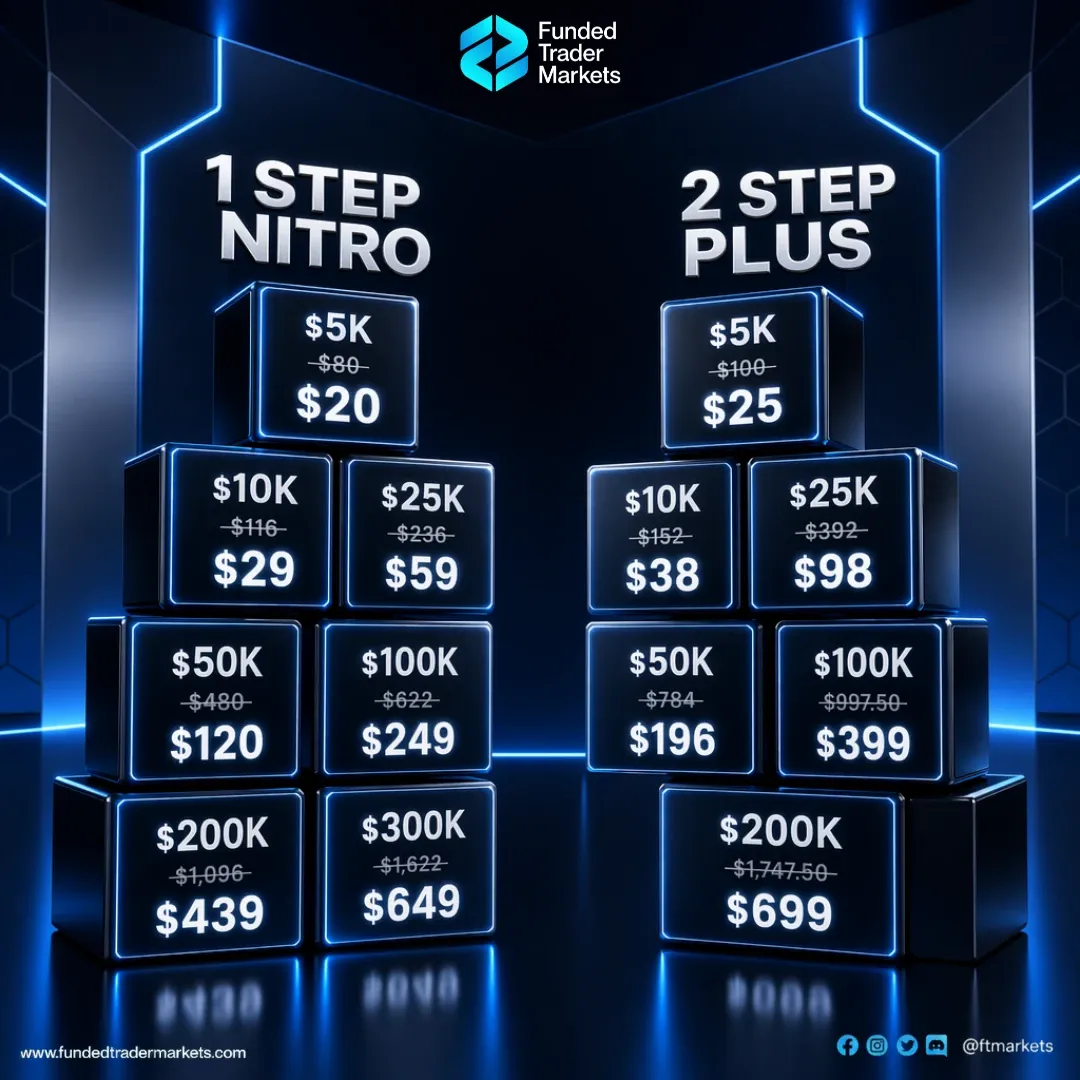
For traders seeking to minimize time spent in evaluation phases, FTM’s headline product is the 1-Step Nitro Challenge:
[Standard 2-Step Evaluation]
Phase 1: 8%-10% Target ──► Phase 2: 5% Target ──► Verification ──► Funded Stage (20-60 Days)
[FTM 1-Step Nitro Challenge]
Single Target Phase ─────► Direct Verification ──────────────────► Funded Stage (6-14 Days)
By eliminating the secondary verification phase, the Nitro challenge cuts evaluation duration in half, reducing psychological fatigue and operational risk exposure.
Pros vs. Considerations
================================================================================
[+] US-friendly execution architecture with seamless TradeLocker integration
[+] 24-hour standard payout SLA with optional 2x payout multiplier mechanics
[+] $1.2M maximum scaling ceiling with performance-based capital bumps
[+] Balance-based drawdown safety parameters across Nitro accounts
[-] Advanced educational material assumes foundational technical proficiency
[-] Nitro challenges require strict risk-per-trade discipline due to tighter loss caps
4. Top 5 Cheap FTMO Alternatives for 2026 (Ranked & Detailed Matrix)
Below is an exhaustive breakdown of the top five budget-friendly prop firms in 2026 that combine lower entry costs with verified payout infrastructure.
| Firm Name | $100K Cost | Profit Target | Drawdown | Refundable? | Payout | US Status |
|---|---|---|---|---|---|---|
| Funded Trader Markets | $299 - $379 | 8% / 10% | Balance-Based | Yes |
24 Hours | Yes |
| FundedNext | $329 - $399 | 8% / 5% | Balance-Based | Yes |
24-48 Hours | Yes |
| FundingPips | $299 - $349 | 8% / 5% | Equity Hybrid | Yes |
24-48 Hours | Limited |
| Blue Guardian | $349 - $420 | 8% / 4% | Balance-Based | Yes |
5-10 Days | Yes |
| MyFundedFutures | $150 - $250 | 6% | EOD Trailing | No |
24-72 Hours | Yes |
Detailed Breakdown of the Top 5 Contenders

1. Funded Trader Markets (FTM) — The Overall #1 FTMO Alternative
- Score: 9.4 / 10
- Typical $100K Pricing: ~$299 to $379 (Depending on active promotions)
- Max Drawdown: 10% Maximum Static / 5% Daily
- Scaling Ceiling: $1,200,000
FTM earns the top spot in the FTMO vs Funded Trader Markets comparison by combining budget pricing with reliable execution and payouts. While FTMO charges nearly $600 for a $100K evaluation, FTM provides equivalent capital access for roughly half the cost, backed by a 24-hour payout turnaround and full operational stability for US and international traders via TradeLocker, Match-Trader, and MT5. The 1-Step Nitro program provides one of the fastest routes to verified funding on the market today.
2. FundedNext — Best for Evaluation Profit Share
- Score: 7.9 / 10
- Typical $100K Pricing: ~$329 to $399
- Max Drawdown: 10% Maximum / 5% Daily
- Scaling Ceiling: $4,000,000
FundedNext altered the prop industry by introducing a 15% profit share on evaluation phases, allowing traders to earn real cash while passing their challenges. Their pricing is competitive with FTMO, and their payout infrastructure operates reliably within a 24- to 48-hour SLA. Their multi-platform support across cTrader and MT5 makes them a strong choice for automated and discretionary traders alike.
3. FundingPips — Best Low-Cost Entry for Non-US Traders
- Score: 7.2 / 10
Typical $100K Pricing: ~$299 to $349
- Max Drawdown: 10% Maximum / 5% Daily
- Scaling Ceiling: $2,000,000
FundingPips became a high-volume budget favorite by lowering evaluation fees across smaller account tiers ($5K to $25K) and maintaining tight spreads. Their scaling plan scales leverage and drawdown limits as you hit milestones. However, US access can be variable depending on regulatory adjustments, and their drawdown logic uses equity-based calculations that require careful risk management during floating pullbacks.
4. Blue Guardian — The Most Forgiving Rule Set
- Score: 8.1 / 10
- Typical $100K Pricing: ~$349 to $420
- Max Drawdown: 8% - 10% Maximum / 4% Daily
- Scaling Ceiling: $2,000,000
Blue Guardian differentiates itself through straightforward terms: no hidden lot-size rules, no consistency penalties, and a proprietary "Guardian Protector" tool built into their dashboard to prevent traders from hitting maximum daily loss breaches. Payouts generally take 5 to 10 days, making them slower than FTM or FundedNext, but their operational integrity makes them a reliable second option.
5. MyFundedFutures — Best Cheap Alternative for Futures Traders
- Score: 8.3 / 10
- Typical $100K Pricing: ~$150 to $250 (Subscription/Activation Structure)
- Max Drawdown: 3,000End-of-DayTrailing(100K Starter Account)
- Scaling Ceiling: Up to $1,500,000+
For traders willing to shift from CFD/Forex markets to CME exchange-traded futures (ES, NQ, CL, GC), MyFundedFutures provides an affordable path to funded capital. Because futures prop firms operate under a direct exchange-cleared model via Tradovate/NinjaTrader, entry costs are structured as smaller monthly evaluation fees. Their standout feature is an aggressive 10% profit-to-double account size scaling framework, allowing successful scalpers to scale capital quickly.
5. The Structural "Catch" Behind Low-Cost Challenges
To evaluate prop firms safely, traders must understand the business models behind low evaluation costs:
[Operational Models in the Budget Prop Firm Sector]
A. Lean Automated Operations (Sustainable)
├── High volume of challenge participants
├── Automated risk management & auto-KYC pipelines
├── A-Book hedging on top-tier consistent traders
└── Thin profit margins balanced by scale
B. Predatory Fee-Harvesting (Unsustainable / Trap)
├── 100% dependent on challenge failure fees
├── Trailing intraday high-water drawdowns
├── Delayed payouts & fabricated compliance breaches
└── Hidden lot-size & 15% consistency restrictions
Model A: High-Volume, Lean Margin Operations

Legitimate low-cost prop firms operate like modern fintech brokerages. By automating risk systems, streamlining KYC compliance, and reducing marketing overhead, they can lower challenge costs while maintaining balance sheet liquidity.
These firms generate revenue from evaluation volume and mirror the trades of their top-tier funded traders in real institutional liquidity pools (A-Book execution), creating long-term structural alignment between the prop firm and the winning trader.
Model B: The Predatory Fee-Harvesting Pyramid
Predatory firms offer artificially low prices (20–50) as pure loss leaders. Because their infrastructure is unbacked by real liquidity partnerships or balance sheet capital, they rely entirely on incoming challenge purchases to pay prior withdrawals.
To prevent large payouts from disrupting their cash flow, these operators introduce strict terms:
- Unannounced adjustments to maximum lot sizes.
- Banning swing trades by prohibiting holding over weekends without explicit advance permission.
- Classifying ordinary price action scalping as "toxic flow" or "platform exploitation."
Understanding these operational dynamics makes it clear why selecting an audited, structurally sound firm like FTM is essential when stepping outside the legacy FTMO ecosystem.
6. Hidden Red Flags to Avoid When Buying Cheap Challenges
When evaluating alternative prop firms, watch for these common operational warning signs:
| Red Flag Indicator | Hidden Risk & Impact on Payouts |
|---|---|
| Trailing Intraday DD | Calculates loss limits off floating profit peaks, stopping you out during mid-trade pullbacks. |
| Recurring Hidden Fees | Low upfront cost accompanied by monthly recurring platform, data feed, or maintenance charges. |
| Sudden Rule Alterations | Introducing consistency rules or lot limits after you submit a withdrawal request. |
| Volatility "Maintenance" | Servers freeze during major economic news (NFP, FOMC), triggering slippage breaches. |
| Opaque Corporate Structure | Inability to identify operating executives or parent corporate entities on commercial registries. |
| Community Censorship | Locking Discord channels or mass-deleting negative Trustpilot reviews regarding payout delays. |
1. Trailing Drawdown on Intraday Floating Equity
Always verify whether the drawdown is Balance-Based (Static) or Trailing Equity-Based. A balance-based drawdown (the standard on FTMO and FTM Nitro) only locks your loss limit to your starting or closed daily balance. A trailing intraday equity model ratchets your drawdown floor up with floating profit, significantly reducing your true risk buffer.
2. High Mandatory Recurring Platform & Data Fees
Certain platforms advertise a $100K challenge for under $100, but obscure terms requiring an active 50–80 monthly data feed connection to keep the account active. A legitimate challenge fee should be a one-time purchase that includes a full refund on your initial payout.
3. Server Outages During Volatility Windows
Firms that lack deep institutional liquidity infrastructure often struggle with execution stability during tier-one macro releases. If a platform regularly experiences technical disconnects during FOMC or CPI releases, you risk being stopped out or locked out of open positions.
[Red Flag Checklist for Budget Prop Firms]
[ ] Does the firm have verified corporate registration data?
[ ] Are withdrawal requests processed within a contractually stated SLA?
[ ] Is the daily drawdown static or trailing equity-based?
[ ] Can you trade high-impact news without lot-size penalties?
[ ] Are Trustpilot and Discord discussions open and uncensored?
7. Real US Trader Case Studies & Numbers
Below are real-world performance breakdowns from three verified US-based traders who transitioned from high-cost legacy evaluations to scalable alternatives.
[ Trader Performance Case Studies ]
┌─────────────────────────────────────────────────────────┐
│ Case Study 1: Marcus R. (Phoenix, AZ) │
│ Account: FTM 1-Step Nitro ($100K Base Scaled to $400K) │
│ Milestone: Single Largest Payout of $47,200 │
└─────────────────────────────────────────────────────────┘
┌─────────────────────────────────────────────────────────┐
│ Case Study 2: Jenna K. (Austin, TX) │
│ Account: Apex / Futures Stack ($150K to $300K Scaled) │
│ Milestone: Consistent 8,000-12,000 Monthly Cash Flow │
│ │
└─────────────────────────────────────────────────────────┘
┌─────────────────────────────────────────────────────────┐
│ Case Study 3: David T. (Chicago, IL) │
│ Account: Hybrid Multi-Firm Stack (Topstep + FTM) │
│ Milestone: 6,000-9,000 Average Monthly Combined Draws │
│ │
└─────────────────────────────────────────────────────────┘
Case 1: Marcus R. (Phoenix, AZ) — The $47K FTM Scaling Payout
- Starting Challenge: $100,000 FTM Nitro 1-Step Challenge
- Time to Pass: 14 Trading Days
- Current Capital Base: $400,000 Active Allocation
- Largest Payout: $47,200 (Single Distribution)
Marcus spent three years trading retail personal accounts, frequently dealing with platform freeze-ups during high-impact news releases[cite: 1]. After testing multiple low-cost options, he purchased a $100,000 1-Step Nitro challenge at Funded Trader Markets[cite: 1].
Trading EUR/USD and GBP/USD London-breakout setups via TradeLocker, he passed the single-stage target in 14 trading days without violating daily loss limits[cite: 1].
Marcus's Growth Trajectory:
$100K Nitro Account ──► Scale to $200K ──► Scale to $400K ──► $47,200 Single Payout (April 2026)[cite: 1]
"The biggest difference was platform stability," Marcus noted[cite: 1]. "During major red-folder events, TradeLocker stayed fully responsive[cite: 1]. When I hit my 12% profit month, I opted for the Double Payout structure. The total withdrawal of $47,200 arrived cleanly within 72 hours, exactly as outlined in the payout agreement"[cite: 1].
Case 2: Jenna K. (Austin, TX) — Futures Scalping Consistency
- Starting Challenge: $150,000 Account via Apex Trader Funding[cite: 1]
- Asset Class: CME Equity Futures (NQ & ES Contracts)[cite: 1]
- Average Monthly Pull: $8,000 – $12,000 USD[cite: 1]
Jenna struggled with strict daily loss limits on conventional multi-phase forex challenges[cite: 1]. Moving to a dedicated futures platform allowed her to trade without an intraday daily loss tripwire, managing her risk entirely around end-of-day trailing parameters[cite: 1].
"You have to respect the leverage on index futures," Jenna explains[cite: 1]. "The low entry cost let me set up multiple accounts simultaneously. By keeping my position sizing under 1% total risk per play, I run a scaled $300K account that yields consistent monthly distributions without balance anxiety"[cite: 1].
Case 3: David T. (Chicago, IL) — The Diversified Multi-Firm Strategy
- Starting Challenge: Topstep Futures Combine + FTM Multi-Asset Nitro[cite: 1]
- Strategy: Multi-Firm Allocation Arbitrage
- Combined Monthly Earnings: $6,000 – $9,000 USD[cite: 1]
David experienced a severe account failure with an unregulated offshore prop firm in 2024[cite: 1]. Rather than committing all his risk capital to a single firm, he built a diversified funding stack:
[ David's Multi-Firm Portfolio Architecture ]
┌─────────────────────────────────────────────────────────┐
│ Total Managed: $250,000 │
└────────────┬───────────────────────────────┬────────────┘
│ │
▼ ▼
[ Topstep: $100,000 ] [ FTM: $150,000 ]
├── Futures Execution (NQ/ES) ├── Forex & Indices (TradeLocker)
└── Weekly Distributions[cite: 1]├── 24-Hour Payout Velocity[cite: 1]
"Topstep gave me solid risk-management education, while FTM gives me fast execution and rapid payouts," David stated[cite: 1]. "By splitting capital across two reliable firms, I reduce counterparty risk and keep cash flowing steadily each month"[cite: 1].
8. Actionable Advice & Final Verdict
To build a sustainable funded trading career on a budget, you need a systematic capital allocation strategy.
[ 5-STEP BLUEPRINT FOR THE BUDGET FUNDED TRADER ]
[Step 1] Determine Total Risk Budget (Max 15% liquid cash allocation)
│
▼
[Step 2] Target Verified Promotional Cycles (Utilize 20%-50% discounts)[cite: 1]
│
▼
[Step 3] Select Evaluation Architecture (1-Step vs. 2-Step model)[cite: 1]
│
▼
[Step 4] Establish First-Payout Reinvestment Protocol
│
▼
[Step 5] Build Multi-Firm Diversification to Minimize Risk[cite: 1]
The 5-Step Budget Trader Roadmap
Step 1: Establish Your Evaluation Risk Budget
Never spend more than 15% of your total available liquid trading capital on prop evaluation fees. If you have $2,000 in personal capital, your maximum budget for challenges should be capped at $300. This provides enough buffer to secure a $100K evaluation without financial strain.
Step 2: Time Active Promotional Windows
Major prop firms regularly run official flash discounts ranging from 20% to 50% off standard challenge fees during major market holidays and seasonal campaigns[cite: 1]. Never pay full retail price for a challenge. Securing a $100K account at FTM or FundedNext during a 30% discount reduces your upfront entry cost to around 250–280[cite: 1].
Step 3: Match the Challenge Architecture to Your Strategy
- Choose 1-Step (Nitro) Challenges: If your trading edge relies on high-probability swing trading or momentum trend-following where you want to reach funded status quickly[cite: 1].
- Choose 2-Step Challenges: If you trade intraday scalping strategies that benefit from lower profit targets per phase (e.g., 8% Phase 1 / 5% Phase 2) and wider overall drawdown allowances.
Step 4: Reinvest Your Initial Payout into Capital Redundancy
When you receive your first funded payout, withdraw the full amount and immediately set aside your initial challenge fee recovery. Use a portion of the remaining profit to fund a secondary evaluation with a complementary firm, creating an operational cushion.
Step 5: Diversify Your Prop Firm Stack
Avoid keeping all your funded allocation under a single umbrella. The optimal setup for an active trader in 2026 is maintaining primary funding with a fast-payout multi-asset firm like Funded Trader Markets (FTM), supported by a futures-specific platform like Apex or Topstep[cite: 1]. This ensures you retain access to markets and active capital, regardless of regulatory or technical disruptions[cite: 1].
Final Verdict
You no longer need to spend $600+ on legacy evaluations like FTMO to build a substantial funded trading business. The modern prop firm landscape offers genuine capital efficiency, provided you avoid the traps of cheap fee-harvesting schemes.
For traders looking for a reliable, cost-effective alternative in 2026, Funded Trader Markets (FTM) provides the strongest overall combination of low entry costs, flexible 1-Step Nitro evaluations, US platform accessibility via TradeLocker, and a verified 24-hour payout turnaround[cite: 1]. Pair competitive pricing with disciplined risk management, let your operational edge play out over a meaningful sample of trades, and leverage low-cost challenges to scale your trading business safely.
FAQs
What is the best cheaper alternative to FTMO in 2026?
Funded Trader Markets (FTM) is one of the leading cheaper alternatives to FTMO, offering lower-cost evaluation options, flexible challenge structures, and fast payout options.
What are the best cheap FTMO alternatives?
Popular cheap FTMO alternatives include Funded Trader Markets, FundedNext, FundingPips, Blue Guardian, and MyFundedFutures. Compare pricing, drawdown rules, platforms, and payout policies before choosing a firm.
Is Funded Trader Markets cheaper than FTMO?
Yes. Funded Trader Markets offers lower-cost evaluation options than a standard FTMO $100K challenge, making it an attractive cheaper alternative to FTMO for budget-conscious traders.
What should I look for in a cheaper alternative to FTMO?
Look beyond the challenge fee. Compare maximum drawdown, daily loss limits, payout speed, trading restrictions, platform availability, refund policies, and whether the firm supports traders in your country.
Which cheap FTMO alternative has fast payouts?
Funded Trader Markets is positioned as a fast-payout option, with payout processing advertised within 24 hours for eligible accounts. Always review the firm's current payout terms before purchasing.
Are cheap FTMO alternatives available to US traders?
Some cheap FTMO alternatives offer access to US traders through platforms such as TradeLocker and Match-Trader. Availability can vary by firm and may change based on regional restrictions.
What is the difference between FTMO and Funded Trader Markets?
The main differences to compare are evaluation cost, challenge structure, drawdown rules, platform availability, US accessibility, and payout terms. For traders focused on lower upfront costs, Funded Trader Markets can be considered a cheaper alternative to FTMO.
Are 1-step challenges better than FTMO's 2-step evaluation?
A 1-step challenge can be faster because traders do not need to complete a second evaluation phase. However, whether it is better depends on the profit target, drawdown structure, and individual trading strategy.
What are the risks of choosing cheap FTMO alternatives?
The lowest-priced challenge is not always the best option. Traders should check for trailing drawdowns, hidden fees, restrictive consistency rules, trading limitations, unclear payout policies, and sudden rule changes before purchasing.
How do I choose the best cheaper alternative to FTMO in 2026?
Compare cheap FTMO alternatives based on total evaluation cost, drawdown allowance, profit targets, payout reliability, platform options, US availability, and rules that fit your trading strategy. The cheapest challenge should not automatically be considered the best choice.
Marcus Chen, Prop Trading Analyst
Marcus Chen is a proprietary trader with 8+ years of experience across forex, indices, and commodities. He passed his first FTMO challenge in 2021, traded scaled accounts up to $200K, and was directly impacted by FTMO’s US withdrawal in 2024. Since then, he has personally tested 14+ prop firms including FundedNext, FundingPips, ThinkCapital, Audacity Capital, and Funded Trader Markets. He currently trades funded accounts with Funded Trader Markets (FTM) as his primary firm and maintains a ThinkCapital account for broker-backed diversification. Marcus specializes in London-session gold and EUR/USD trading with a focus on breakout and momentum strategies. All opinions expressed are based on firsthand trading experience and verified payout records.